
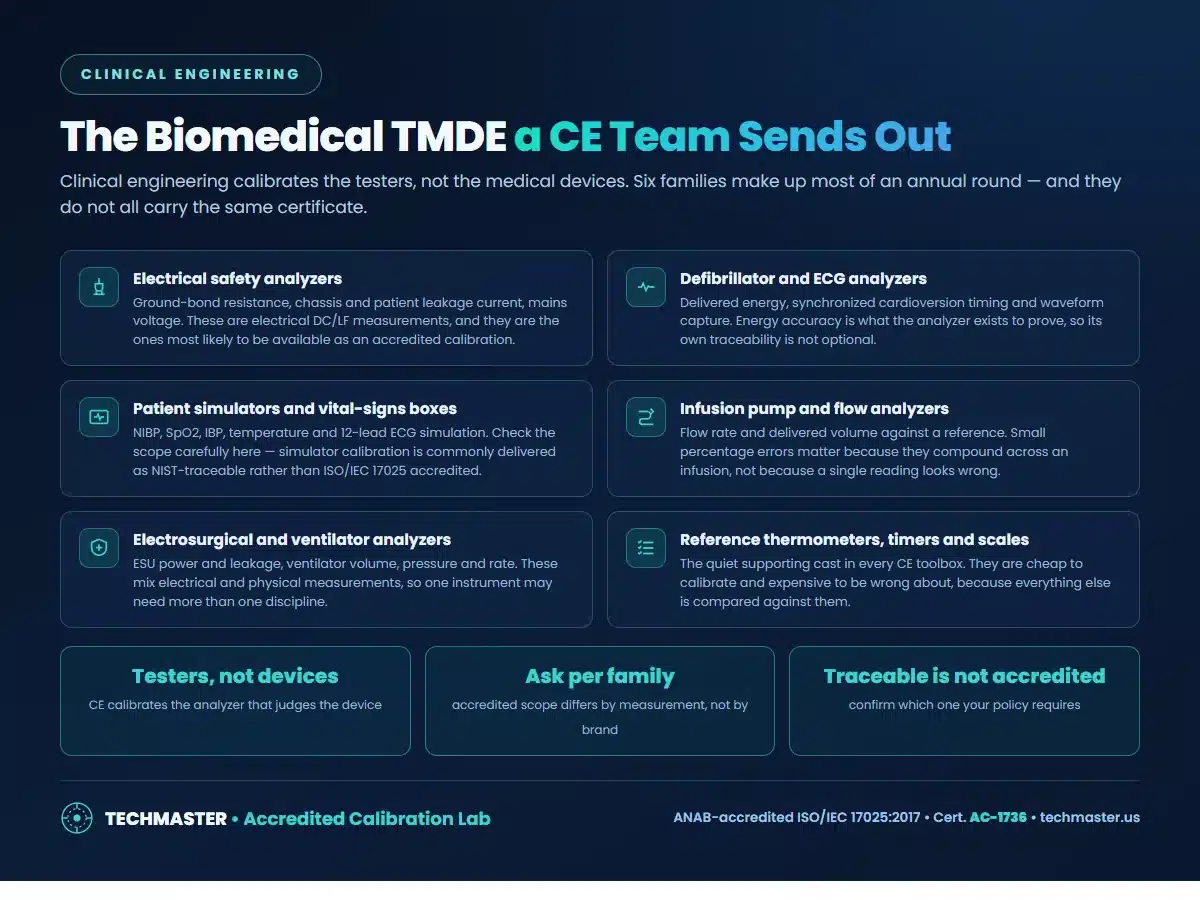
TL;DR: Clinical engineering calibrates the testers, not the medical devices. Six families make up most of an annual round: electrical safety analyzers, defibrillator and ECG analyzers, patient simulators, infusion and flow analyzers, electrosurgical and ventilator analyzers, and reference thermometers, timers and scales. They do not all carry the same certificate, simulators are often NIST-traceable rather than accredited.
A clinical engineering department is in an unusual position: it is the quality function for a fleet of devices it did not make, and the only thing standing behind its judgements is the accuracy of the boxes it tests with. The device inventory gets all the regulatory attention. The analyzer inventory decides whether that attention was worth anything.
What counts as biomedical test equipment?
The instruments that judge medical devices rather than the devices themselves. In practice that is the six families above, plus whatever a particular service line has accumulated. The distinction matters commercially as well as technically: a medical device manufacturer’s obligations under ISO 13485 concern the equipment used to make and release product, while a hospital’s clinical engineering team is calibrating the equipment used to keep devices safely in service. Different rules, similar metrology.
Why can’t every analyzer get an accredited certificate?
Because accreditation is granted for measurement parameters and ranges, not for instrument categories. A laboratory’s scope lists what it is assessed to measure and how well; anything outside that list can still be calibrated competently and traceably, but the certificate cannot carry the accreditation mark. This is why patient simulators so often come back NIST-traceable while an electrical safety analyzer comes back accredited, not because one job was done more carefully, but because the underlying measurements sit in different places relative to the scope. How to read an accreditation scope is the practical skill here, and certificate levels compared sets out what each document actually asserts.
Which measurements sit where?
Electrical safety analyzers are the straightforward case: ground-bond resistance, chassis and patient leakage current and mains voltage are DC and low-frequency electrical measurements, and they map onto established calibration disciplines cleanly. The same reasoning covers the insulation and safety testers used on the facilities side. Defibrillator analyzers, infusion analyzers and ventilator analyzers mix electrical with energy, flow, volume and pressure, so a single instrument can touch more than one discipline and may come back with a certificate that is accredited for part of its capability. Ask parameter by parameter rather than instrument by instrument.
How should a CE department schedule the round?
Most teams run one annual cycle so the toolkit is never half current, which makes the recall system the load-bearing part of the program: asset ID, due date, certificate and as-found data retrievable together. Where an analyzer produces a pass-or-fail safety verdict, treat interval extension conservatively, the argument is the same one made for safety testers, where a drift does not merely shift a number but flips a conclusion. If uncertainties appear on your certificates and you are unsure how to use them against a device tolerance, measurement uncertainty explained covers the arithmetic.
Frequently asked questions
What is biomedical test equipment calibration?
It is the calibration of the analyzers and simulators a clinical engineering department uses to test medical devices, not the calibration of the medical devices themselves. Electrical safety analyzers, defibrillator and ECG analyzers, patient simulators, infusion pump analyzers and ventilator analyzers all produce the verdicts that decide whether a device stays in service, so their own traceability is what makes those verdicts meaningful.
Can patient simulators be calibrated to ISO/IEC 17025?
Not always, and this is the single most common surprise in a biomedical calibration quote. Simulator calibration is frequently delivered as NIST-traceable rather than accredited, because accreditation is granted for specific measurement parameters and ranges rather than for instrument categories. Ask the laboratory to confirm against its published scope for the exact parameters you need, and confirm what your own policy actually requires before assuming the two must match.
Which biomedical analyzers are most likely to carry an accredited certificate?
Generally the ones whose measurements sit in well-established electrical disciplines. Electrical safety analyzers measure ground-bond resistance, leakage current and mains voltage, which are DC and low-frequency electrical measurements that accredited scopes commonly cover. Mixed physical measurements such as flow, pressure and delivered energy vary far more between laboratories, so they have to be checked parameter by parameter rather than assumed.
How often should biomedical test equipment be calibrated?
Twelve months is the usual starting interval, and many clinical engineering departments align the whole toolkit to a single annual round so that the department is never partly out of date. Adjust from documented as-found history rather than habit, and give priority to any analyzer whose result is a pass-or-fail safety verdict, because those are the instruments where a quiet drift changes conclusions rather than just numbers.
The bottom line
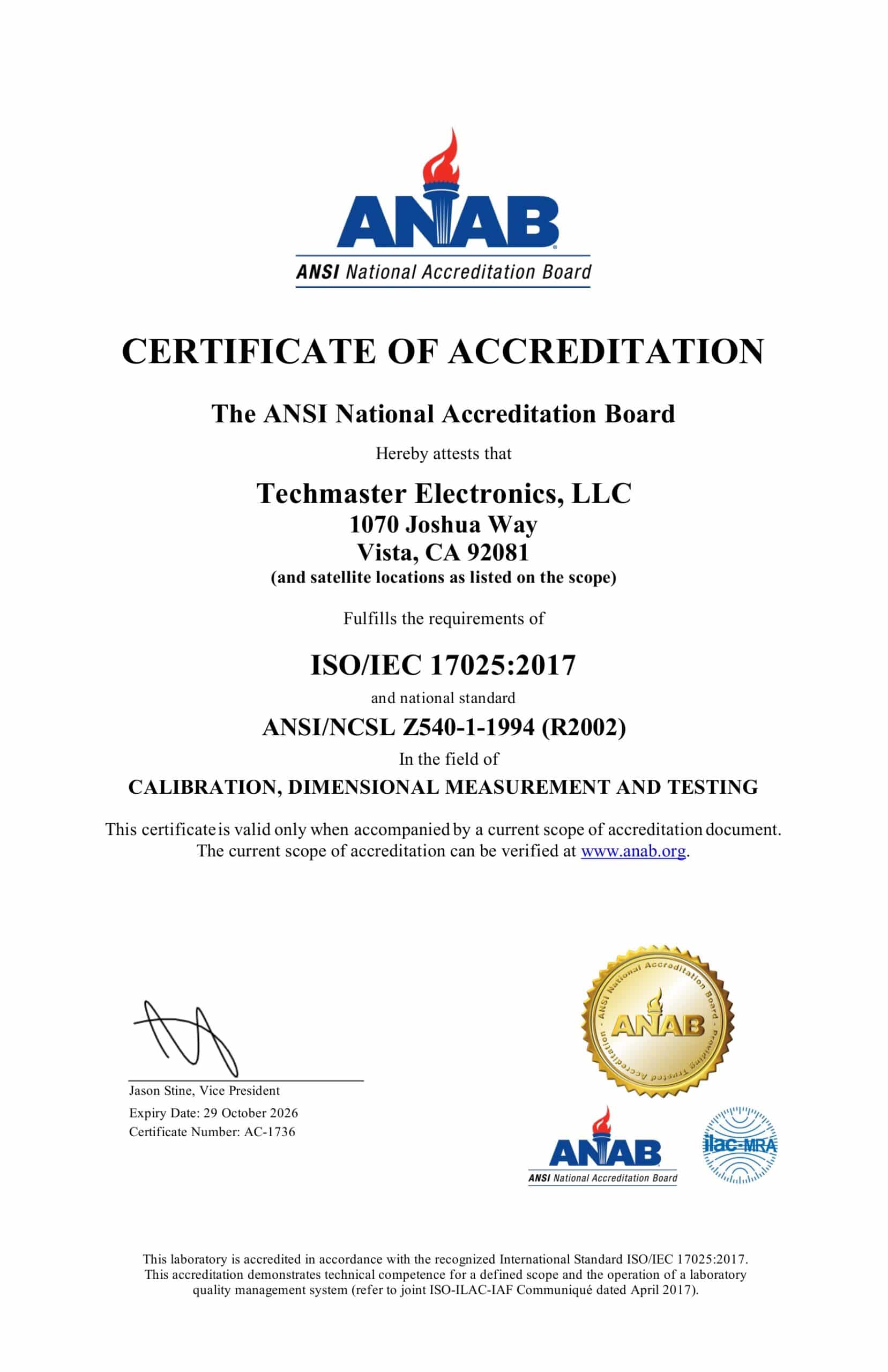
Calibrate the testers on one annual cycle, and check accredited scope per measurement parameter rather than assuming it follows the instrument. Techmaster is ANAB-accredited to ISO/IEC 17025:2017 (Cert. AC-1736) across five US labs and eight calibration fields, send your analyzer list and ask which parameters fall inside the accredited scope and which would be quoted as NIST-traceable.
Get an accredited calibration quote
ANAB-accredited ISO/IEC 17025:2017 (Cert. AC-1736) • 5 US labs • 5-day standard, 1–2 day expedite • in-lab or on-site.
Request a quote
Khanh Nguyen is the Marketing Manager at Techmaster Electronics, a B2B marketing leader covering the test, measurement, and ISO/IEC 17025 accredited calibration industry in the United States.