
TL;DR: It is rare and survivable. Work performed while the lab held accreditation for that parameter generally remains valid evidence, but you need a documented assessment saying so, not an assumption. Watch for the quieter version too: a lab keeping accreditation while dropping your parameter or narrowing your range. Check the accreditation body’s directory at each renewal cycle, and build that check into your recall calendar.
Nobody plans for this, which is why it becomes a finding. The scenario is not dramatic, usually it surfaces when an auditor pulls a certificate, checks the issuing lab in the directory, and finds something you didn’t know.
What to do, in order
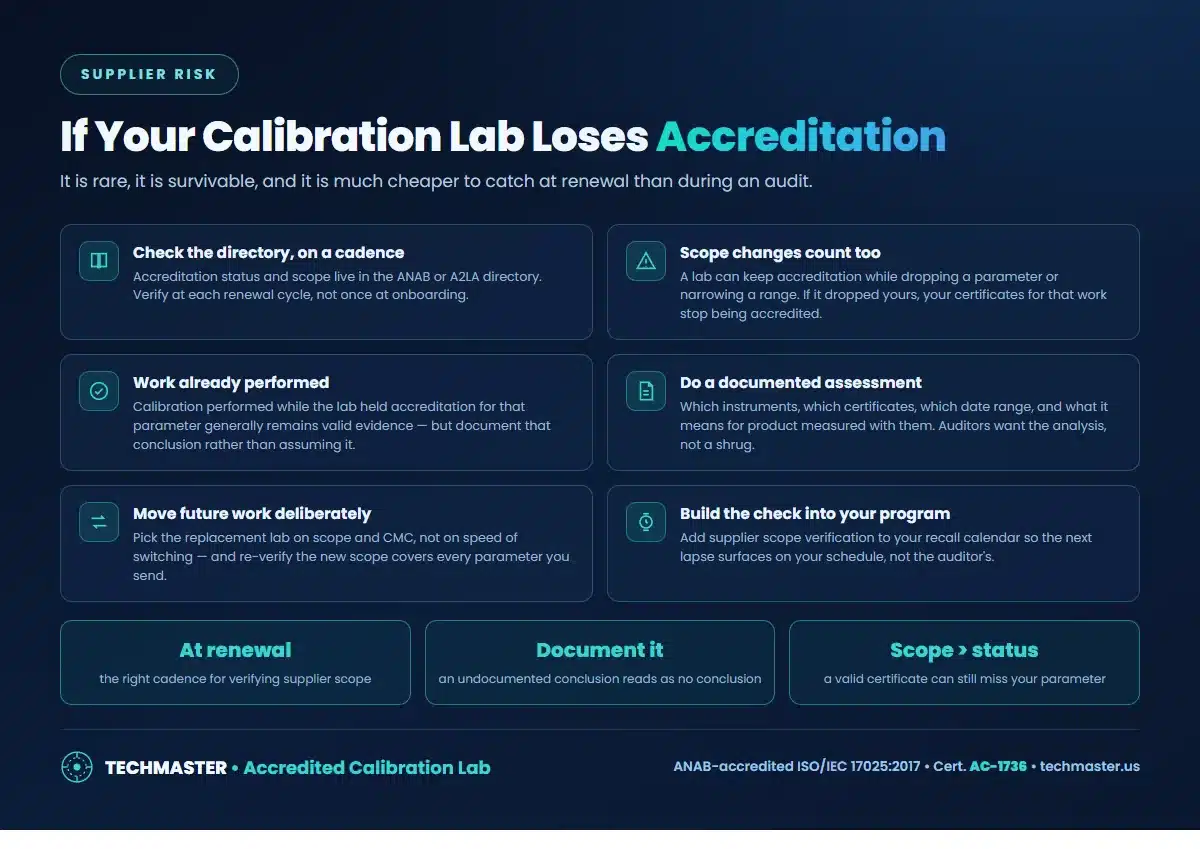
Establish the timeline. When did accreditation lapse or the scope change, and which of your certificates fall on each side of that date? Assess what it means. Calibration performed while the lab was accredited for that parameter generally remains valid evidence; certificates issued afterwards are not accredited certificates, whatever they look like. Write the conclusion down, instruments, certificates, date range, and the impact on product measured with them. This is the same discipline as an out-of-tolerance impact assessment, and auditors evaluate it the same way: they want the analysis, not reassurance.
The quieter risk: scope changes
Full accreditation withdrawal is rare. Scope reduction is less rare and much easier to miss, because the lab remains accredited, just not for what you send it. A dropped parameter or a narrowed frequency range means your calibrations for that work stopped being accredited without any visible change. This is exactly why the vetting habit in how to read an accreditation scope has to be recurring rather than one-off, and why certificate level and scope are two questions rather than one.
Prevention: make it a scheduled check
Add supplier scope verification to your calibration calendar at each renewal cycle, the same calendar your recall system already runs. Keep the current directory copy of each lab’s scope on file, since that is what auditors ask for anyway, and what AS9100 and IATF 16949 supplier-control clauses require. Five minutes per lab per year converts a potential finding into a routine record.
Frequently asked questions
What happens to my certificates if my calibration lab loses accreditation?
Calibration performed while the laboratory held accreditation for that parameter generally remains valid evidence, accreditation lapsing later does not retroactively invalidate work done under it. What your quality system needs is a documented assessment saying so: which instruments, which certificates, which date range, and what it means for product measured with them. Auditors accept a reasoned conclusion; they do not accept silence.
How would I even find out that a lab lost accreditation?
By checking the accreditation body’s directory, ANAB or A2LA, on a regular cadence rather than once at onboarding. Build the check into your calibration recall calendar so it happens at each renewal cycle. Labs are not obliged to announce a lapse to you, and a certificate issued afterwards may look identical to earlier ones.
Is a narrowed scope as serious as losing accreditation entirely?
For you, it can be worse, because it is harder to notice. A laboratory can retain accreditation while dropping a parameter or reducing a frequency or voltage range. If the parameter it dropped is the one you send, your calibrations for that work are no longer accredited even though the lab is still ‘accredited’ in general terms.
What should I do about future calibration work?
Move it deliberately rather than urgently. Select the replacement laboratory on scope coverage and CMC against your tolerances, verify the new scope line by line for every parameter you send, and update your approved supplier records. Then add scope verification to your recurring calendar so the next lapse surfaces on your schedule.
The bottom line
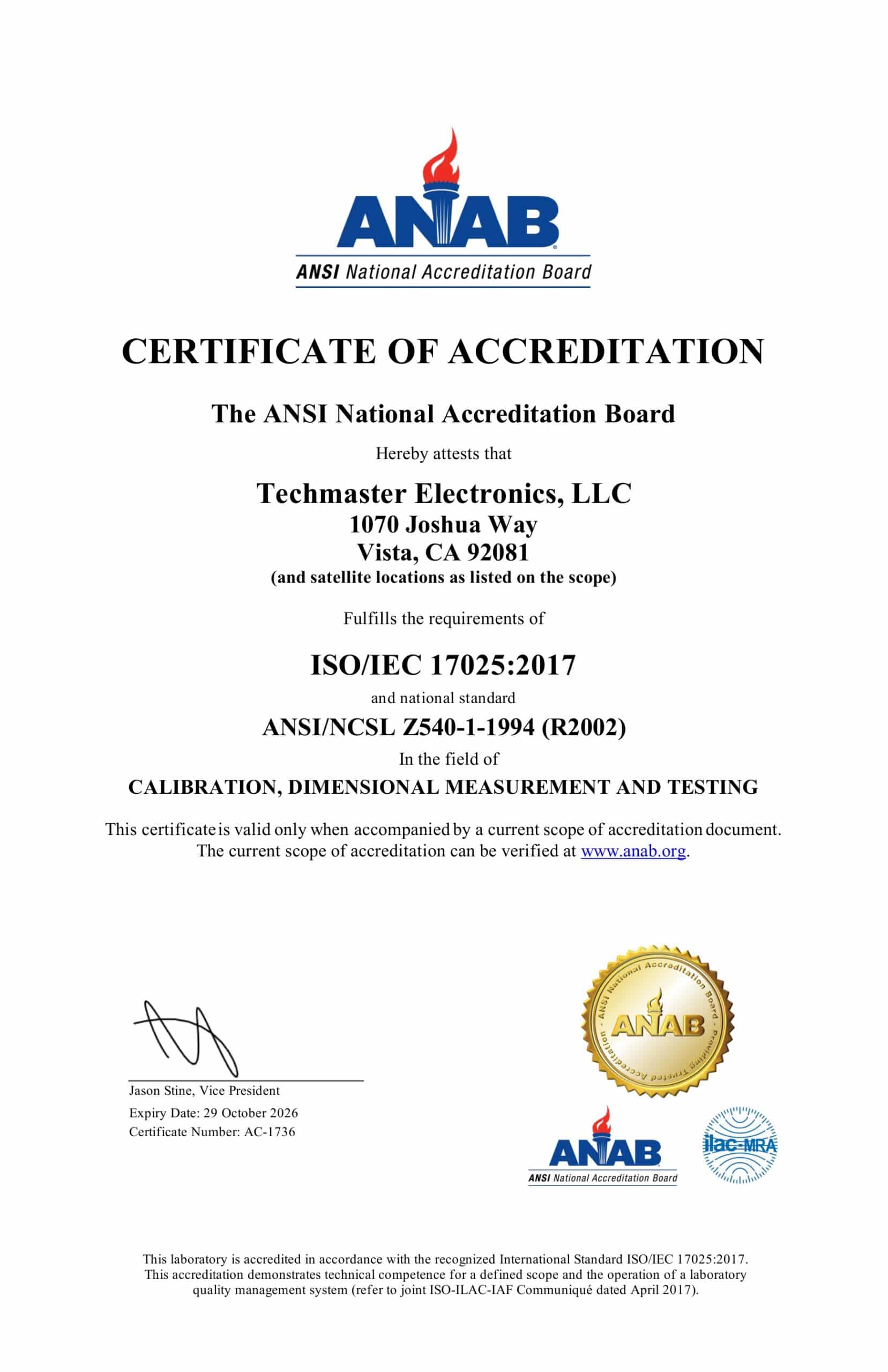
Verify supplier scope on a cadence, document your conclusion if something changes, and choose replacements on scope and CMC rather than urgency. Techmaster’s ANAB accreditation (Cert. AC-1736) is verifiable in the ANAB directory, check it there, not here, which is precisely the point.
Get an accredited calibration quote
ANAB-accredited ISO/IEC 17025:2017 (Cert. AC-1736) • 5 US labs • 5-day standard, 1–2 day expedite • in-lab or on-site.
Request a quote
Khanh Nguyen is the Marketing Manager at Techmaster Electronics, a B2B marketing leader covering the test, measurement, and ISO/IEC 17025 accredited calibration industry across the US and Vietnam markets.