
TL;DR: A power sensor cal factor is the frequency-dependent correction that turns absorbed power into power incident on the connector, folding effective efficiency and input mismatch into one number. It goes wrong when the table does not match the sensor, when the 50 MHz reference is mistaken for a calibration, when interpolation spans a curving response, or when a worn connector changes the match it was measured against. Mismatch is usually the largest uncertainty term.
What is a power sensor calibration factor?
A power sensor calibration factor is a per-frequency correction that relates the power absorbed by the sensing element to the power actually incident on the sensor connector, combining the sensor’s effective efficiency and its input mismatch into a single number. Because both quantities vary with frequency, the cal factor is a table rather than a constant, and applying the wrong entry produces a confident, incorrect reading with no error indication of any kind.
RF power sensors and meters were a recurring cluster in the requests reaching our laboratories over the last two quarters, weighted toward requests for accredited calibration rather than repair, which is consistent with an instrument whose whole value is the number in its table.
How do cal factors go wrong in practice?
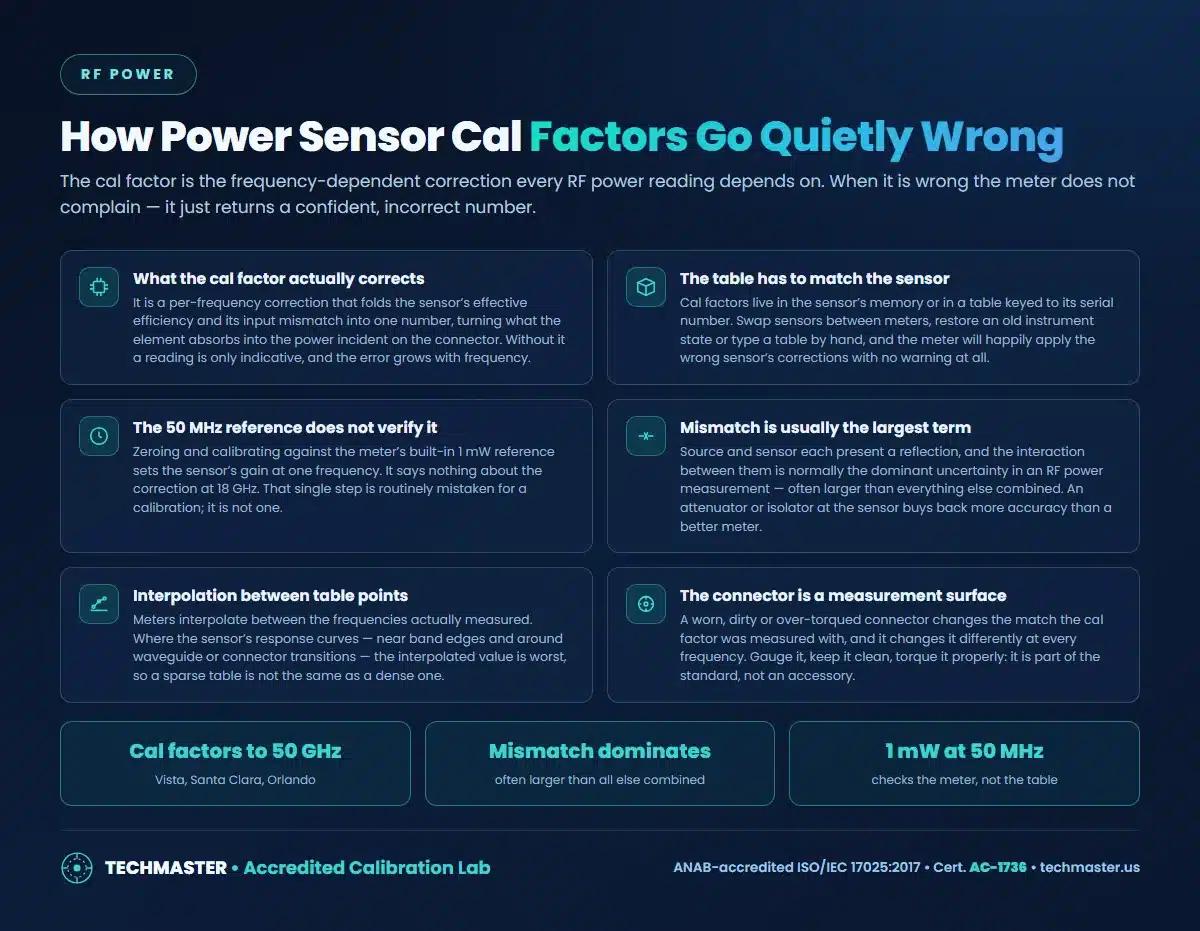
Six ways, none of which the meter reports: the loaded table belongs to a different sensor, the 50 MHz reference step is mistaken for a calibration of the table, the measurement frequency was never entered so a default correction is applied, interpolation spans a region where the response curves, mismatch is left uncontrolled, or the connector has worn and no longer presents the match the factors were measured against.
What these share is silence. A power meter has no way to know that the table it is applying describes a different sensor, and it will not warn you that the correction at your frequency was interpolated across a gap.
Why does the 50 MHz reference not verify the table?
Because it operates at exactly one frequency. Zeroing and calibrating against the meter’s built-in 1 mW 50 MHz reference sets the sensor’s gain at 50 MHz and confirms the meter and sensor are working together. It says nothing whatever about the correction applied at 18 GHz, and treating that daily routine as a calibration is the most common error in RF power measurement.
A genuine calibration measures the sensor against traceable standards across its frequency range and issues a new table with stated uncertainties. The distinction between the levels of certificate available for that work is set out in accredited versus NIST-traceable calibration.
What dominates the uncertainty budget?
| Uncertainty contributor | Typical significance | What reduces it |
|---|---|---|
| Source-to-sensor mismatch | Usually the largest single term | A well-matched attenuator or isolator at the sensor |
| Cal factor uncertainty | Significant, and grows with frequency | A denser table and a recent accredited calibration |
| Interpolation between table points | Worst where the response curves | Measure at tabulated frequencies where possible |
| Instrumentation and linearity | Moderate, across the power range | Calibration covering the power levels you use |
| Connector repeatability | Moderate, and often underestimated | Gauging, cleaning and correct torque |
| Zero drift and noise | Small, except at low power levels | Zero close to the measurement, average for longer |
Mismatch dominating is the practically useful conclusion: an attenuator at the sensor input usually buys back more accuracy than a better power meter. Building the full budget is covered in measurement uncertainty and traceability, and what the resulting numbers mean on a certificate in test uncertainty ratio and decision rules.
Why is the connector part of the measurement?
Because the cal factor was measured with a particular reflection coefficient at the sensor input, and a worn, dirty or over-torqued connector changes that match, differently at every frequency. Gauging, cleaning and correct torque are not housekeeping; they are what keeps the table valid. The same discipline governs the reference standards in VNA calibration kit verification.
What capability stands behind power sensor calibration?
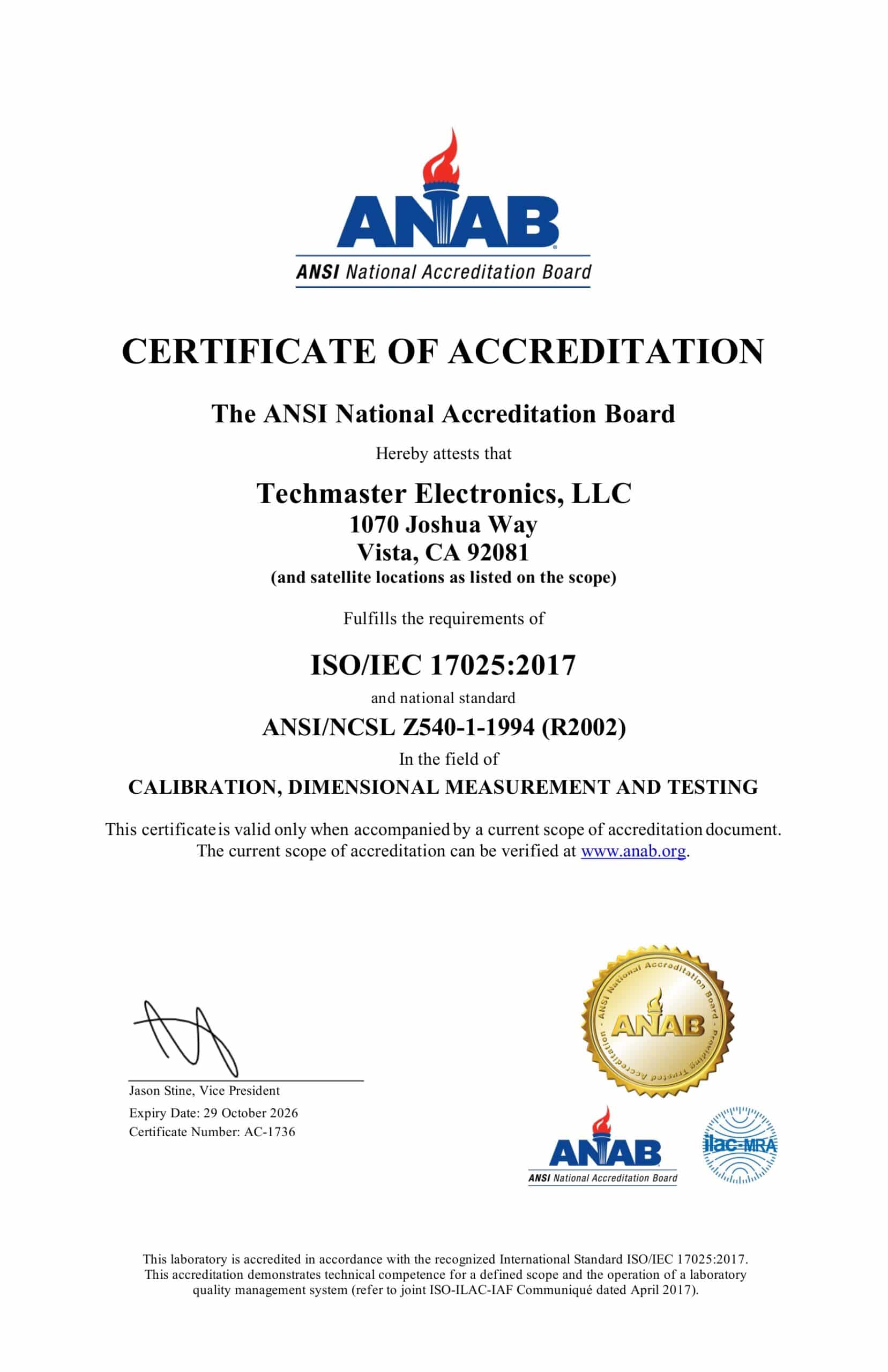
RF and microwave calibration, including power sensor calibration factors to 50 GHz, sits on Techmaster’s ANAB ISO/IEC 17025 scope (Cert. AC-1736) at the Vista, Santa Clara and Orlando laboratories. RF and microwave work is not performed under that scope at San Antonio, so confirm the laboratory as well as the parameter. What an accredited scope actually entitles a laboratory to claim is explained in calibration and measurement capability. Instrument-level coverage is in RF power sensor calibration, average power sensor calibration and RF power meter calibration; sector requirements in RF and microwave calibration for AS9100; and the service itself in our RF and microwave calibration service.
Frequently asked questions
What is a power sensor calibration factor?
It is a per-frequency correction that turns what the sensing element absorbs into the power actually incident on the connector. It folds the sensor’s effective efficiency and its input mismatch into a single number, and because both vary with frequency, so does the cal factor. Without it an RF power reading is only indicative, and the error grows as frequency rises.
Does zeroing and calibrating against the 50 MHz reference verify the cal factors?
No, and this is the most common misunderstanding in RF power measurement. The built-in 1 mW 50 MHz reference sets the sensor’s gain at one single frequency. It says nothing about the correction applied at 18 GHz or anywhere else in the table. That step is a necessary daily routine, not a calibration of the sensor.
What is usually the largest uncertainty in an RF power measurement?
Mismatch, in most practical setups. The source and the sensor each present a reflection and the interaction between them is normally the dominant term – often larger than everything else combined. Fitting a good attenuator or an isolator at the sensor input usually buys back more accuracy than upgrading the power meter does.
Can I use a cal factor table from a different sensor of the same model?
No. Cal factors are specific to the individual sensor and are keyed to its serial number, because effective efficiency and input match vary between units. Swapping sensors between meters, restoring an old instrument state or typing a table by hand will make the meter apply the wrong corrections silently, with no warning and no error message.
The bottom line
Match the table to the sensor, enter the real frequency, control the mismatch, and treat the connector as part of the standard. Send the sensor model, its serial number and the frequencies you actually measure at, and the calibration can be specified against the measurement rather than the datasheet.
Need a quote, a rental, or a repair evaluation?
Techmaster Electronics, ISO/IEC 17025 accredited calibration laboratory, ANAB Cert. AC-1736, founded 1989. Five US labs, 5-day standard turnaround, 1–2 day expedite.
Request a quote →Techmaster Electronics, LLC is an independent ISO/IEC 17025:2017 accredited calibration laboratory. We are not affiliated with, authorized by, or endorsed by any manufacturer named on this page. All product names and model designations are trademarks of their respective owners and are used here only to identify the equipment we calibrate, repair, or rent. Confirm that our accredited scope covers your instrument’s parameters and ranges before shipping, ask us and we will check it against your model list.

Khanh Nguyen is the Marketing Manager at Techmaster Electronics, a B2B marketing leader covering the test, measurement, and ISO/IEC 17025 accredited calibration industry in the United States.