
TL;DR: A calibration procedure exists so two technicians on two different days get the same result. It needs six sections: scope and applicability, reference standards and TUR, environmental conditions and soak time, test points, sequence and tolerances, as-found recorded before adjustment, and approval, revision control and training. The as-found rule is the one that decides whether your data is usable later.
Most calibration procedures fail in the same two ways: they are too generic to apply to a specific instrument, and they leave the as-found rule implied. Both are avoidable, and both produce audit findings that are tedious to close.
What belongs in a calibration procedure?
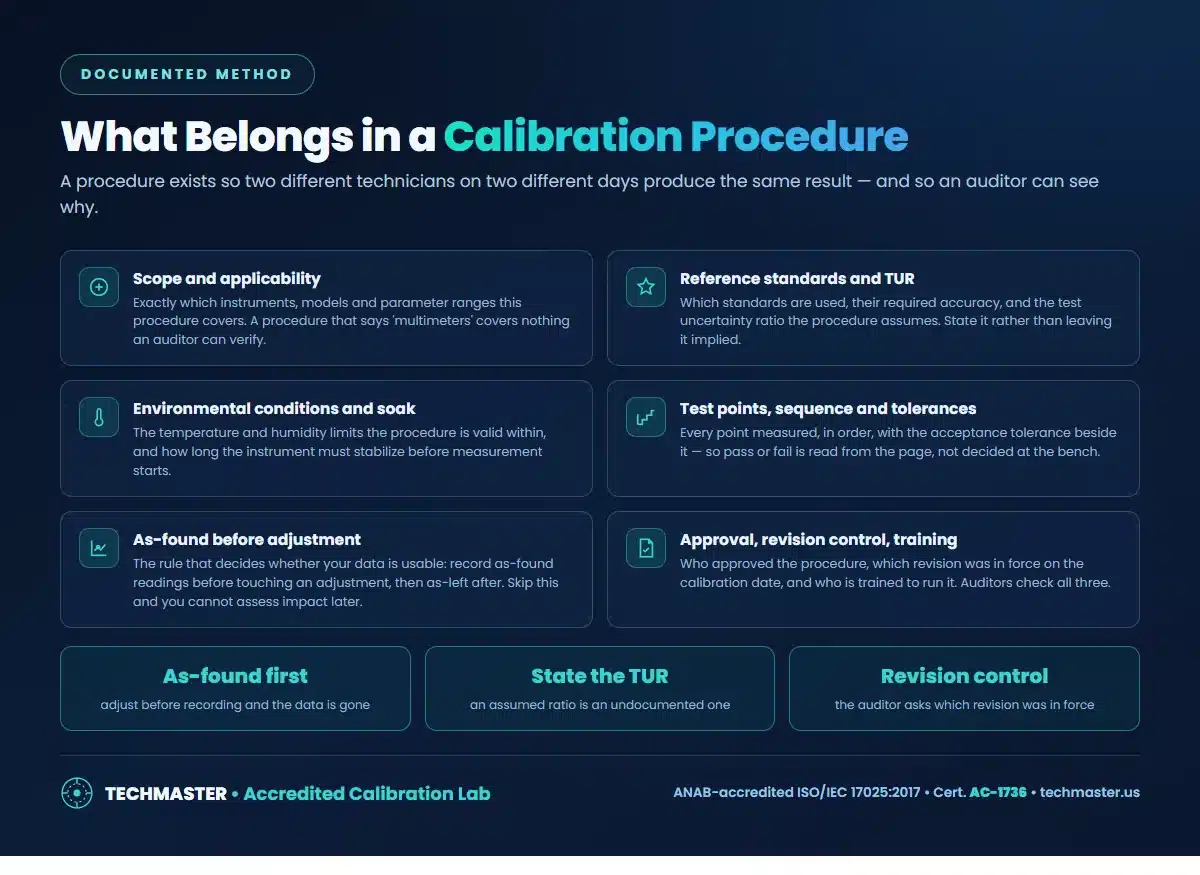
Scope and applicability comes first and does most of the work: exactly which models and which parameter ranges the procedure covers, at a level of detail that lets a technician confirm the instrument in front of them is in scope. Reference standards and TUR should be stated, not implied, which standards, what accuracy they need, and the test uncertainty ratio the method assumes; the concept is unpacked in measurement uncertainty explained. Environmental conditions and soak time define the conditions the procedure is valid within and how long the instrument must stabilize first, which matters more than most procedures admit, see how lab environment changes your measurements. Test points, sequence and tolerances turn judgement into reading: every point, in order, with its acceptance limit beside it. As-found before adjustment is the rule that preserves your evidence. And approval, revision control and training is what makes the document a control rather than a note.
The as-found rule, and why it comes first
Everything else in a procedure can be corrected later. As-found data cannot: adjust the instrument and the record of how far it had drifted is gone permanently. That record is what supports an out-of-tolerance impact assessment if the instrument failed, and it is the evidence base for extending a calibration interval if it passed comfortably. The distinction between recording, adjusting and repairing is worth being explicit about in the procedure itself, calibration vs verification vs adjustment vs repair covers why those are four different services with four different outputs.
Make the procedure specific enough to be usable
Generic procedures are the most common finding in this area. “Calibration of multimeters” cannot be verified as applied correctly, because the reader cannot tell which instruments and ranges it addresses. Write to model families and state the ranges. Where an instrument type has an established published method, referencing it and documenting your deviations is legitimate and faster than writing from scratch, what auditors object to is a procedure so broad that following it is unfalsifiable.
Wire the procedure into the rest of the program
A procedure is one component. It connects to the recall system that schedules the work, the status label the technician applies afterwards, the certificate that records the result, and the software that stores it. Terms used in the document should match the definitions in the calibration glossary so nothing is ambiguous at the bench. If you are building the program rather than one document, start with how to set up a calibration program, and check the result against calibration audit preparation.
Frequently asked questions
What has to be in a calibration procedure?
Six things auditors reliably look for: the scope and applicability (which models and which parameter ranges), the reference standards required and the test uncertainty ratio assumed, the environmental conditions and stabilization time the procedure is valid within, the test points and acceptance tolerances in sequence, the rule that as-found readings are recorded before any adjustment, and the approval, revision control and training records behind the document.
Why is ‘as-found before adjustment’ the most important rule?
Because it is the only one that destroys information if skipped. Once an instrument is adjusted, the evidence of how far out it had drifted is gone, and with it any ability to assess what the instrument was doing to your product measurements over the preceding interval. As-found data also underpins interval justification. Adjusting first is convenient once and expensive later.
Do I need my own procedures if I outsource calibration?
You need procedures for anything you do yourself, in-house checks, intermediate verifications, incoming inspections, and you need a documented method for how outsourced calibration is specified, received and accepted. You do not need to duplicate your laboratory’s internal procedures. What auditors check is that your side of the process is defined rather than improvised.
How specific does the scope section need to be?
Specific enough that a reader can tell whether a given instrument in front of them is covered. Model or model family plus the parameter ranges the procedure addresses is the usable level. A procedure headed with a generic instrument category covers nothing an auditor can verify, and generic procedures are a common source of findings precisely because they cannot be applied consistently.
The bottom line
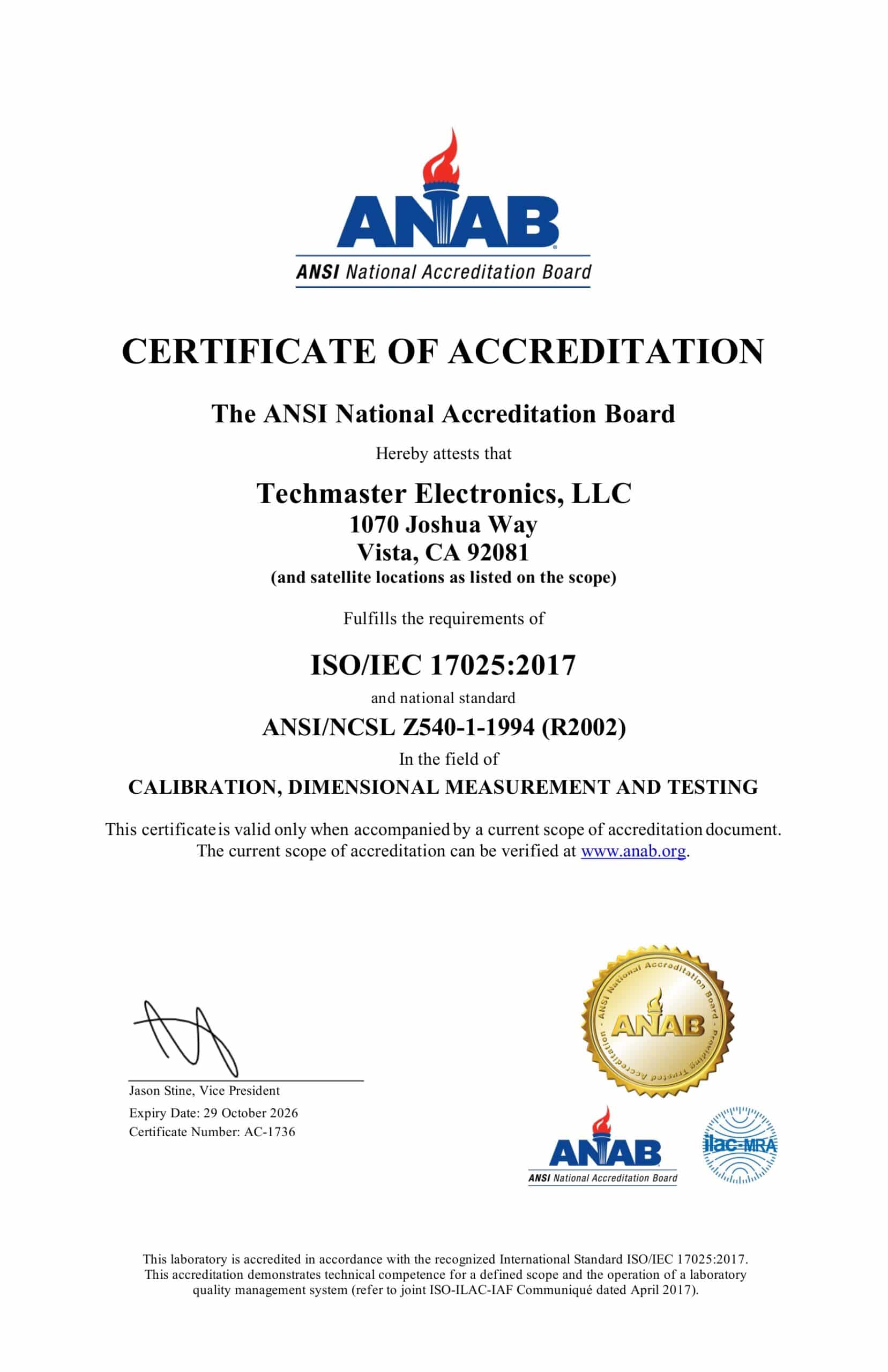
Write to specific models and ranges, state the standards and the TUR, define the environment and soak time, list every test point with its tolerance, record as-found before touching anything, and keep the document under revision control. Techmaster performs accredited calibration to ISO/IEC 17025:2017 (Cert. AC-1736) and supplies the as-found and as-left data your procedures depend on.
Get an accredited calibration quote
ANAB-accredited ISO/IEC 17025:2017 (Cert. AC-1736) • 5 US labs • 5-day standard, 1–2 day expedite • in-lab or on-site.
Request a quoteReferences & industry standards
- ISO/IEC 17025 testing & calibration laboratory requirements
- NIST calibration services and measurement traceability
- A2LA / ANAB accreditation for calibration laboratories
External standards bodies. Techmaster Electronics is an ISO/IEC 17025-accredited, NIST-traceable calibration laboratory.

Khanh Nguyen is the Marketing Manager at Techmaster Electronics, a B2B marketing leader covering the test, measurement, and ISO/IEC 17025 accredited calibration industry in the United States.