
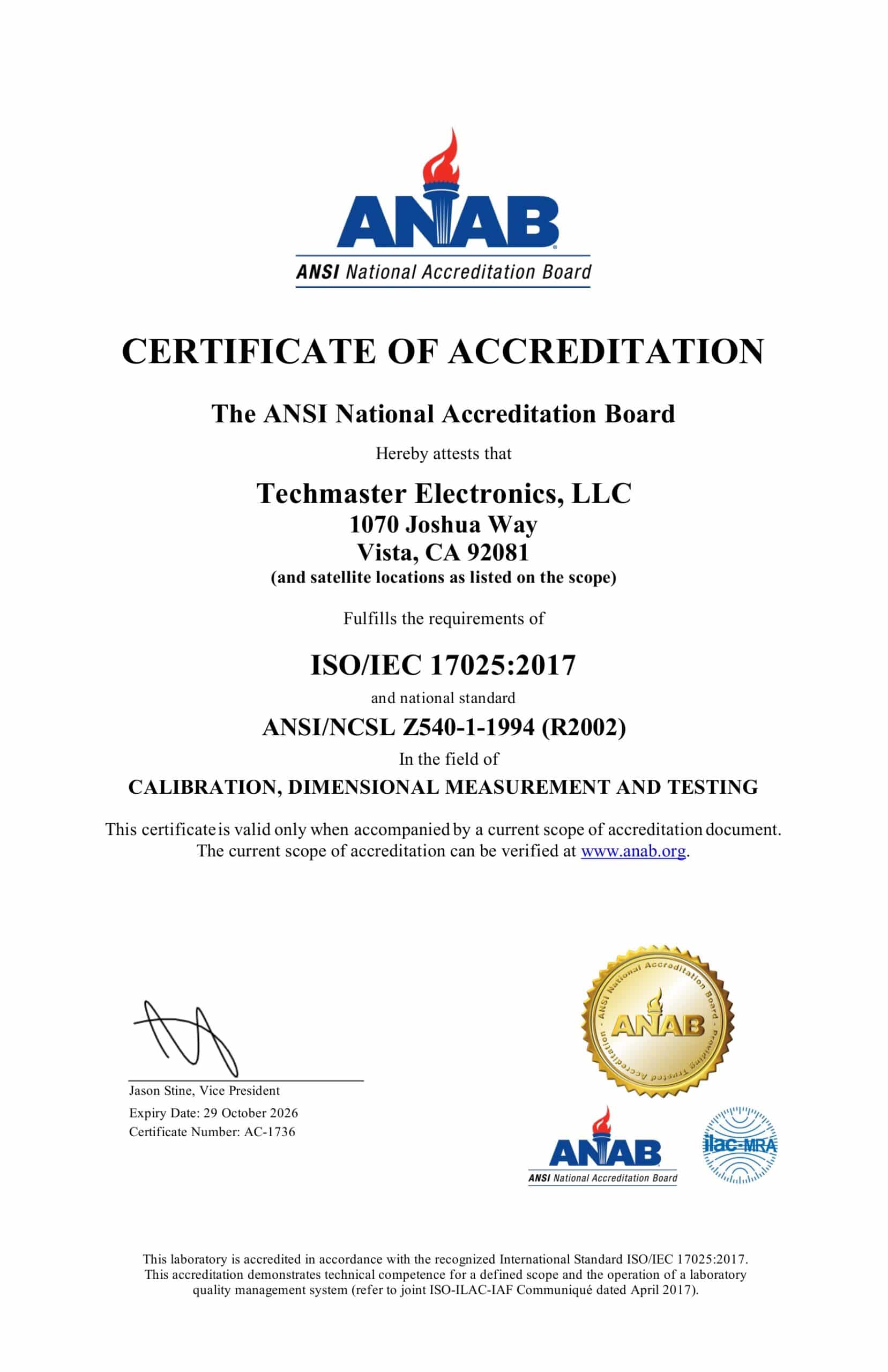
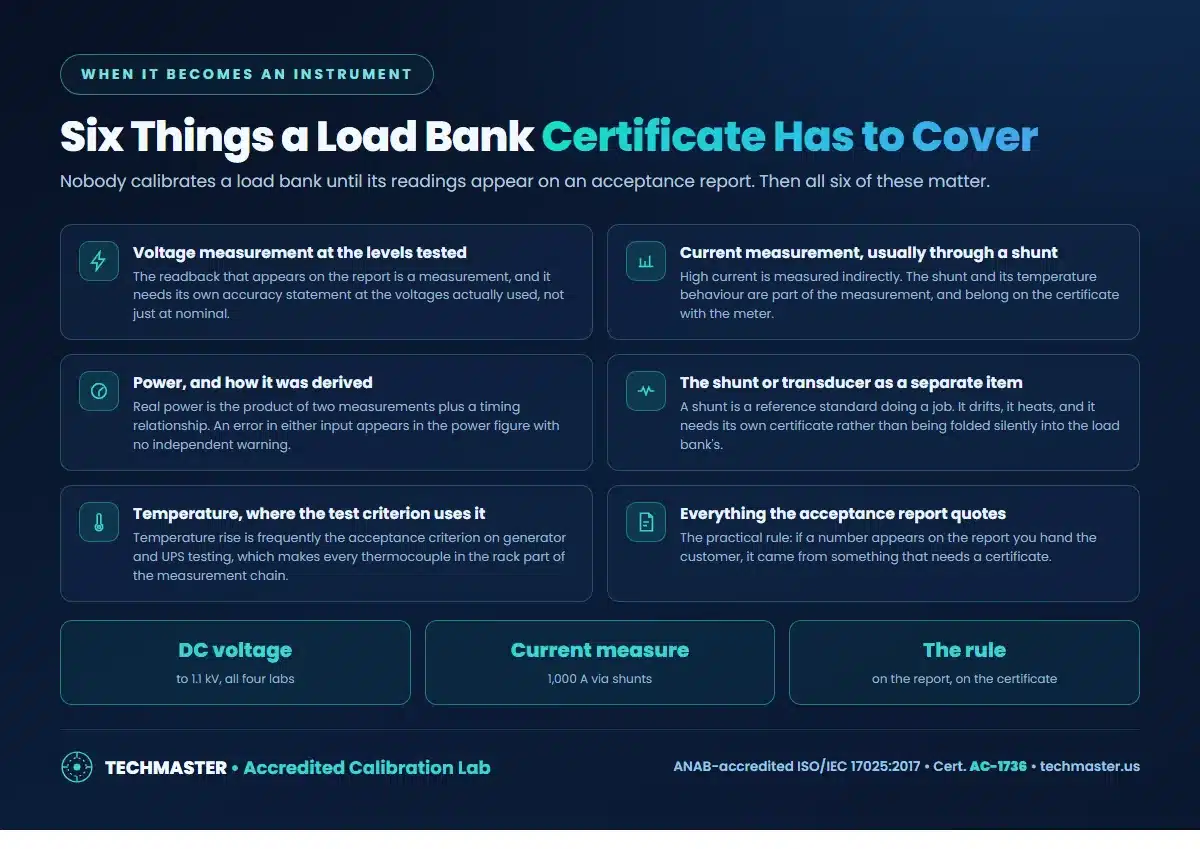
TL;DR: A load bank becomes a measuring instrument the moment its readback appears on an acceptance report, and then the certificate has to cover voltage, current, derived power, the shunt as a separate standard, and any temperature channel the criterion uses. The practical rule: if a number reaches the report, it came from something that needs a certificate. Techmaster calibrates DC voltage to 1.1 kV and measures current to 1,000 A through shunts, across all four scope laboratories.
What is load bank calibration?
Load bank calibration is the verification of a load bank’s measurement channels, voltage, current, power and temperature readback, against traceable standards, so that the figures it reports on a generator, UPS or battery acceptance test can be relied on as evidence.
The confusion is understandable. A load bank looks like an appliance: a box of resistive elements and fans whose job is to absorb power. If that is all it does, it is a heater and needs maintenance, not metrology. But almost no load bank is used that way. It is used because somebody needs to prove a generator held 100% load for four hours, or that a UPS delivered rated output until the batteries reached their end voltage, and the numbers on that report came from the load bank’s instrumentation.
At that point the load bank is doing the same job as a DC electronic load or a power analyzer, and the same reasoning applies to it. how a DC electronic load is calibrated describes what is actually measured on a programmable load, and the argument generalises directly.
What has to be on a load bank calibration certificate?
The measurement channels, each at the levels used, plus the shunt or transducer as a separate item with its own traceability. Not the resistive elements – those are maintenance.
| Item | Why it is on the certificate | What goes wrong if it is not |
|---|---|---|
| Voltage measurement | The readback quoted on the acceptance report | A pass recorded at a voltage nobody verified |
| Current measurement | Derived from a shunt or transducer, not measured directly | Every current and power figure inherits an unknown error |
| Derived power | The product of two measurements plus a timing relationship | Two small input errors combine into a large power error with no warning |
| The shunt or transducer | A reference standard in its own right; it drifts and heats | The component most likely to be responsible is the one nobody checked |
| Temperature channels | Temperature rise is frequently the acceptance criterion | The criterion is evaluated against an unverified reading |
| The resistive elements | Not a calibration item – a maintenance item | Confusion about what the certificate actually promises |
Why does the current shunt need its own certificate?
Because the shunt is the current measurement. Its resistance sets the value, it changes with temperature, and it drifts with age – so a certificate that folds it silently into the load bank’s hides the component most likely to be responsible for an error.
This matters more at high current than almost anywhere else, because the self-heating that shifts a shunt’s value is proportional to the square of the current running through it. A shunt characterised cold and used hot is a systematic error with an obvious physical cause and no visible symptom. AC/DC current shunt calibration covers how shunts are calibrated, and current transducer calibration the alternative approach where a transducer replaces the shunt. Techmaster’s accredited electrical DC and low-frequency capability under ANAB certificate AC-1736 covers DC voltage to 1.1 kV, current sourcing to 20.5 A and current measurement to 1,000 A via shunts, at all four scope laboratories.
When does a load bank actually need calibrating?
When a number it produces is quoted as evidence. If the report says the generator held rated load and the load figure came from the load bank, that figure needs traceability. If the load bank only absorbs power and every reported number came from separate calibrated instruments, it does not.
That test settles most arguments about whether a given unit belongs in the calibration program at all, and it is the same consequence-based reasoning that should govern the rest of the register. The related instruments, power supply calibration, AC/DC power supply calibration and its service scope and how a DC power supply is calibrated on the source side, high-power DC electronic load calibration and how often to calibrate a DC electronic load on the sink side, are decided the same way. Where a unit is hired rather than owned, rent versus buy for a DC electronic load covers the economics and the certificate question together.
How accurate does the load bank have to be?
Better than the tolerance you are judging against, by a margin you have decided deliberately. A load bank reading within 2% cannot support a 1% acceptance criterion, no matter how good its certificate is.
That is the test uncertainty ratio and decision rules argument applied to acceptance testing, and it is worth doing before the test rather than after a disputed result. The uncertainty attached to each figure on the certificate is what makes the calculation possible, see measurement uncertainty and traceability. Where the acceptance test is performed at a customer’s site rather than in a workshop, in-lab versus on-site calibration covers what changes.
Frequently asked questions
Does a load bank need to be calibrated?
It does as soon as its readings appear on an acceptance report. A load bank used only to dissipate power is a heater and needs no certificate; a load bank whose voltage, current, power or temperature readback is quoted as evidence that a generator or UPS passed is a measuring instrument, and it needs one.
What does load bank calibration cover?
The measurement channels rather than the load elements: voltage at the levels tested, current – usually through a shunt or transducer that needs its own certificate – derived power and how it was calculated, and any temperature channels the acceptance criterion relies on. The resistive elements themselves are a maintenance item, not a calibration item.
Does the current shunt need its own certificate?
Yes. A shunt is a reference standard doing a job: it drifts, it changes with temperature, and its value is the basis of every current and power figure the load bank reports. Folding it silently into the load bank’s certificate hides the component most likely to be responsible for an error.
How often should a load bank be calibrated?
Annually is common for units used in acceptance testing, with a check after any repair to the measurement chain or a suspected overload. Units that only dissipate power and produce no reported numbers do not need a calibration interval at all – they need a maintenance one.
The bottom line
Apply one rule: if a number reaches the acceptance report, it came from something that needs a certificate. Calibrate the measurement channels and the shunt, maintain the elements, and check the accuracy against the tolerance you are enforcing before the test rather than after it.
Need a quote, a rental, or a repair evaluation?
Techmaster Electronics, ISO/IEC 17025 accredited calibration laboratory, ANAB Cert. AC-1736, founded 1989. Five US labs, 5-day standard turnaround, 1–2 day expedite.
Request a quote →Techmaster Electronics, LLC is an independent ISO/IEC 17025:2017 accredited calibration laboratory. We are not affiliated with, authorized by, or endorsed by any manufacturer named on this page. All product names and model designations are trademarks of their respective owners and are used here only to identify the equipment we calibrate, repair, or rent. Confirm that our accredited scope covers your instrument’s parameters and ranges before shipping, ask us and we will check it against your model list.

Khanh Nguyen is the Marketing Manager at Techmaster Electronics, a B2B marketing leader covering the test, measurement, and ISO/IEC 17025 accredited calibration industry in the United States.