
TL;DR: An EMC test report is only as traceable as the instruments behind it. Six asset classes need traceable calibration: EMI receivers and spectrum analyzers, antennas (antenna factors), LISNs and coupling networks, amplifiers and transducers, ESD/EFT/surge generators, and current probes and clamps. Annual is the common baseline. If your lab is ISO/IEC 17025 accredited, expect assessors to check both the certificates and your calibration supplier’s accredited scope.
EMC compliance work has a particular exposure: the entire value of a test report rests on instruments whose errors are invisible in the result. A LISN with drifted impedance or an antenna with stale factors produces confident numbers that are simply wrong, and nobody finds out until an assessment, or a field failure.
What EMC equipment must be calibrated?
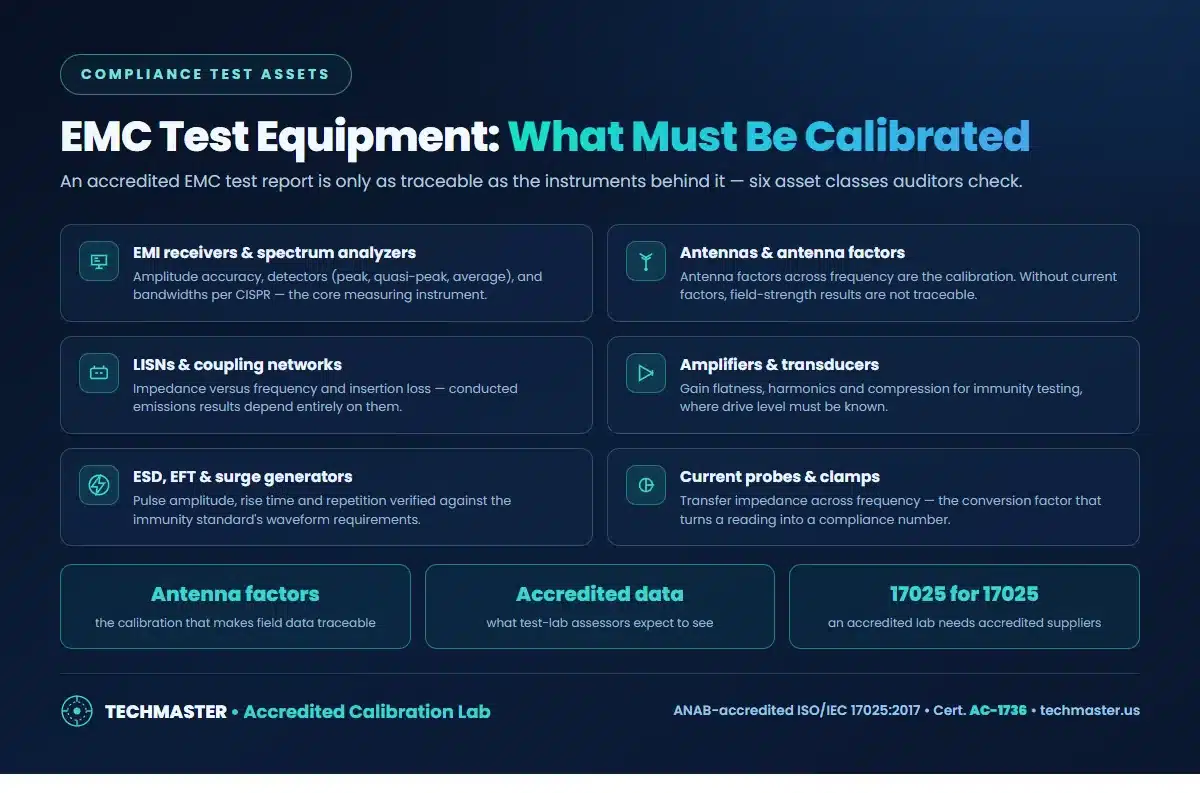
EMI receivers and spectrum analyzers are the core measuring instruments: amplitude accuracy, CISPR detectors (peak, quasi-peak, average), and bandwidth accuracy, the deeper parameter list is in the spectrum analyzer guide. Antennas are calibrated by producing antenna factors across frequency; those factors are the calibration. LISNs need impedance versus frequency and insertion loss, since conducted emissions results depend entirely on them. Amplifiers need gain flatness and compression data for immunity drive levels. ESD, EFT and surge generators need pulse amplitude, rise time and repetition rate verified against the immunity standard’s waveform requirements. And current probes need transfer impedance, the factor that converts a reading into a compliance number.
Traceability is the whole product
For an accredited test lab, calibration isn’t overhead, it’s the mechanism that makes results defensible. Assessors follow the same chain your customers do: the measurement, the instrument, the certificate, the calibrating lab’s accredited scope. That’s why accredited calibration with data beats a pass stamp here more than almost anywhere else, and why supplier scope verification matters (the how-to is in what is ISO/IEC 17025 accreditation). The traceability chain itself is explained in what NIST-traceable calibration means.
Practical program notes
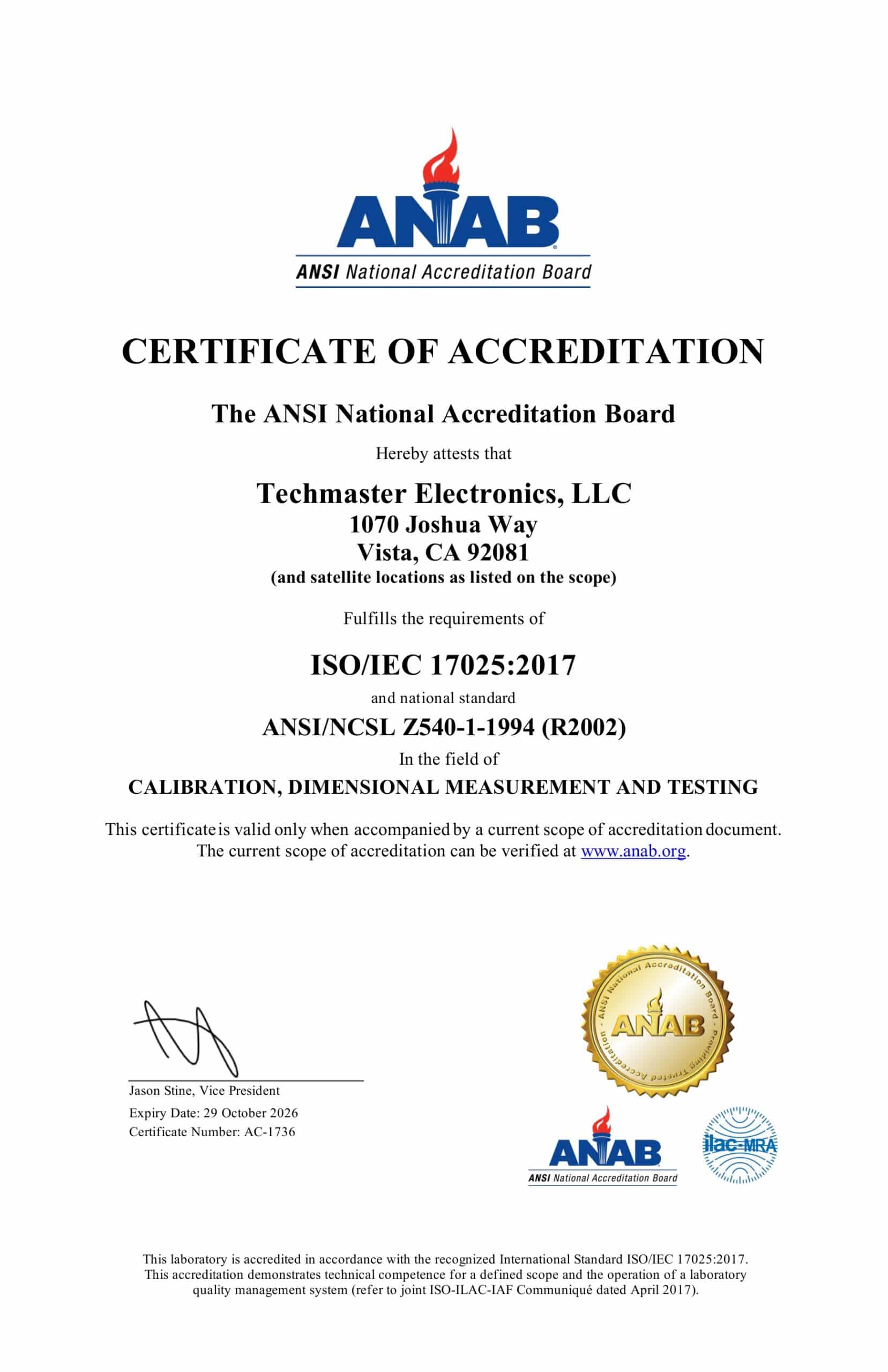
Keep EMC assets on a strict recall system, an overdue antenna invalidates every test performed with it after the due date, and the out-of-tolerance playbook then reaches every report issued in that window. Plan calibration around your test schedule using the levers in turnaround and downtime, and pack antennas and probes carefully for transit (shipping guide). Techmaster calibrates receivers, analyzers, amplifiers, sensors and probes under ANAB accreditation (Cert. AC-1736).
Frequently asked questions
What EMC test equipment needs calibration?
Everything in the measurement chain: EMI receivers and spectrum analyzers, antennas (their antenna factors), LISNs and coupling/decoupling networks, amplifiers and transducers used for immunity testing, ESD/EFT/surge generators, and current probes and clamps. If an instrument’s reading or output contributes to a compliance verdict, it needs traceable calibration.
What are antenna factors and why do they matter?
Antenna factors convert the voltage measured at the receiver into the field strength at the antenna, across frequency. They are what antenna calibration produces. Without current, traceable antenna factors, a field-strength result cannot be traced to national standards, which is exactly what an assessor checks in an accredited EMC test lab.
How often should EMC test equipment be calibrated?
Annual is the common baseline for receivers, antennas, LISNs and generators, adjusted by the lab’s own procedures and any standard or accreditation-body requirement. Antennas that travel to open-area test sites and generators with wearing output components often justify shorter intervals based on as-found history.
Does an accredited EMC test lab need accredited calibration suppliers?
In practice, yes. An ISO/IEC 17025 accredited test laboratory must demonstrate metrological traceability for its measurements, and the cleanest way to do that is calibration from an accredited laboratory whose scope covers the parameter and range. Assessors routinely ask to see those certificates and the supplier’s scope.
The bottom line
In EMC, calibration is the traceability of your report. Verify your calibration supplier’s scope covers each asset class and frequency range you rely on, the criteria are in the 12-point checklist, and the RF-specific requirements in RF and microwave calibration.
Get an accredited calibration quote
ANAB-accredited ISO/IEC 17025:2017 (Cert. AC-1736) • 5 US labs • 5-day standard, 1–2 day expedite • in-lab or on-site.
Request a quote
Khanh Nguyen is the Marketing Manager at Techmaster Electronics, a B2B marketing leader covering the test, measurement, and ISO/IEC 17025 accredited calibration industry across the US and Vietnam markets.